Sunday, August 28, 2016

Borneo Bound - Sandakan Home Stay

This is where we met our new families! We would be spending our time here with Muslim host families; who took amazingly good care of us.  Momma Saloma made us feel right at home with tasty meals and rides to and from school each day.  She even left us notes in our lunch.


On our last night with our Sandakan family, they dressed us up for a farewell celebration. Thanks for all the love and support, Momma Saloma!


Borneo Bound - Settling in, Sepilok

For my third Earth Expeditions class, as part of my graduate program at Miami University of Ohio, I traveled to Borneo, Malaysia with about 20 other biology students and 2 instructors.  There is no possible way that I can do justice to the sights and experiences of this trip in a simple blog post. So, if we should cross paths, please ask me about it. I would love to share with you stories of the amazing people who hosted us, the beauty of Borneo's biodiversity and the endless possibilities of Project Dragonfly.

In mid-June, we all converged at the Sepilok Bed and Breakfast, to meet for the first time. It was not easy getting there. But, after spending half a day at the Istanbul Airport and sleeping in a capsule at the Kuala Lumpur Airport, I arrived in Sepilok five minutes before meeting time. This is me after 47 hours of travel with some of my classmates (and new friends) milling about behind me.


After introductions and orientation, we set out on foot to see the sites.
Our first stop was the Borneon Sunbear Conservation Center.  The Center floored me with its thoughtfulness and design. The elevated walkways were designed so that you could comfortably walk barefoot.

There were a number of Sun Bears sauntering around, some relaxing in trees, others scratching at the ground looking for tasty morsels.

This picture shows some Sun Bear claw marks on a tree.
 After the Sun Bear Center, we stopped at the Sepilok Orangutan Rehabilitation Center.  There are regular feedings at the center, which give great opportunities to see Orangutans in a semi-natural setting.
Our last stop was the Rainforest Discovery Center. This beautifully designed center is replete with elevated walkways that offer unique views into the treetops.

It was hot and humid. We all sweat. A lot. And some of us (me being one of them), had just finished a long journey to get here. We soon crashed, trying to rest up before we set for Sandakan to meet our host families.

Thursday, April 14, 2016

Native Plant Sales and Lists

Here are some great resources for native plant sales and lists of plants for you to use in your yard!

If you know of more, please let me know!

Chattahoochee Nature Center - The Chattahoochee Nature Center has a plant sale each spring. It is a great opportunity to snag some locally sourced native beauties!

Georgia Native Plant Society  - Check out their list of sources for native plants. Also, watch this site for their annual spring plant sale!

Georgia Ornithological Society  - The Georgia Ornithological Society came up with a list of native plants that are attractive for birds!

Atlanta Area Plant Conservation Groups

This is just a beginning. Please share with me other organizations that you know about that support our natural environments here in Georgia!!
http://www.atlantaaudubon.org/


http://chattnaturecenter.org/

http://www.gabotsoc.org/

http://www.gaeppc.org/


http://gnps.org/

www.gos.org

treesatlanta.org


Books on Native Plants

Here in Georgia, we are lucky to have some really conservation botanists who have pulled together amazing resources for us! In addition to Georgia-centric books, I have also included some books from other areas that are really great! 
Bring Nature Home - Dr. Douglas Tallamy, Entomology Professor at the University of Delaware, has created a book that shows us how and why we should use native plants in our yard.
Forest Plants of the Southeast - This book has been a bible of sorts for me for quite some time. It covers a wide array of common native plants in our area.
Native Tress of of the Southeast - This book can help you become a native tree expert, if you want to! Learn how to identify trees even in the winter!
Natural Communities of Georgia - This is an updated version of Dr. Wharton's Natural Environments of Georgia. I cannot say enough good things about this book. It not only describes the habitats we have here in Georgia, it tells you where to go to see the habitats being described. If you want to learn more about the natural areas of Georgia, this is a book you need!

If there are other books that you adore that I have not included here, please let me know in the comments below!

Saturday, October 10, 2015

Namibia - Land of Conservation

This summer, I traveled with Project Dragonfly (https://www.projectdragonfly.org/) to Namibia. Why Namibia, you ask? I asked myself the same thing. Although I did not really have the answer to that question before I went, I was happy to travel to a place that I never expected to see in my life. So, I packed my bags and off I went.


My first view of Namibia was from the plane, as we flew past my destination to the Johannesburg Airport.


On the plane, I met some researchers who were traveling to Namibia to gather some data in support of the theory known as Snowball Earth; which theorizes that at one point, the entire earth was iced over, looking like a snowball. There are areas in northern Namibia where some very old rock is exposed, allowing for them to be extracted and studied. For more information on this theory, check out the website http://www.snowballearth.org/.

The morning of July 3, I gathered with a group of 20 or so strangers, with whom I would explore Namibia. Our destination: the Cheetah Conservation Fund.


The Cheetah Conservation Fund (CCF), founded and directed by Dr. Laurie Marker, works tirelessly to preserve the natural populations of Cheetahs in Namibia. They do this through education, research and more education. The drive, collaboration, insight and experience of the CCF team is truly impressive and inspirational.

Feeding cheetahs.
Vet staff conducing a physical.
Analyzing sperm.
Discussing genetics.
Cheetah tracking data.
Cheetah radio-collar.

You can see more pictures of CCF at my website http://ageorgianaturalist.weebly.com/ or at the CCF website http://cheetah.org/. Of course the strangers of July 3rd became close friends and fellow explorers.


Although I have always known education to be key for successful conservation, I have never seen it done in such a real way as I did at CCF. The CCF staff works directly with local cattle farmers, who sometimes trap and kill cheetahs, to educate them on how to protect their cattle while also allowing the cheetahs to live alongside them. When you have half a day, ask me to tell you about it. You will be impressed. I promise.

The efforts of Dr. Laurie Marker and the incredible conservation biologists that work alongside her are making great strides in conserving not only cheetahs, but native ecosystems, which benefit all.


Thank you, Dr. Marker! And thank you, Project Dragonfly!


Monday, April 20, 2015

Migration and Monoliths

WARNING: This post contains pictures of dead birds. The last picture in this post is especially gruesome.

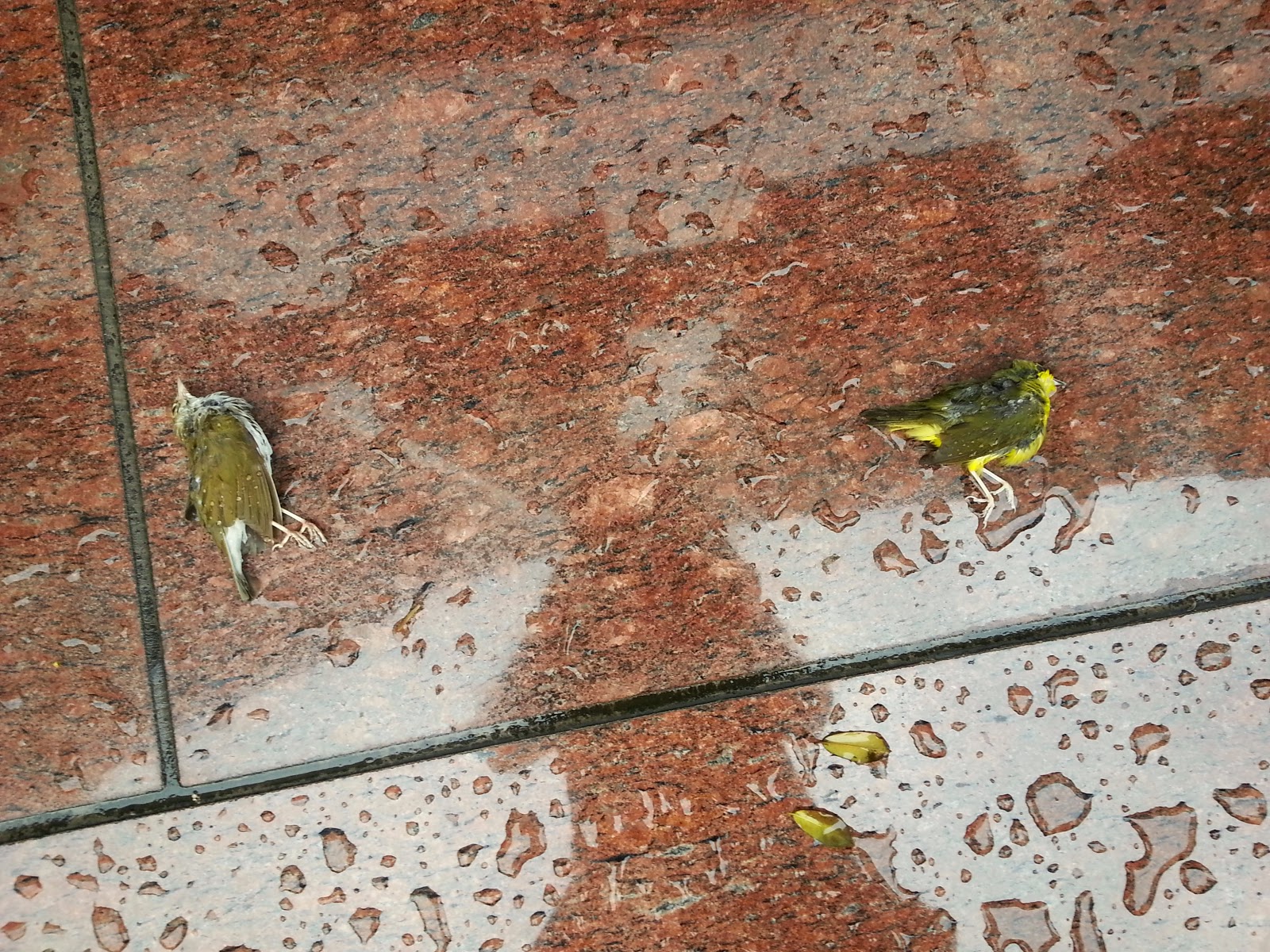
Songbirds migrate under cover of night. They slip by hiding from predators and taking advantage of cooler temperatures. As they make their way across the continent, they encounter lots of things that stand in their way. One example is the towering skyscrapers that populate our cities. 


These monoliths can stand in the way of these little birds that have been flying for hours and hours. Window reflections can disorient these weary travelers and before they know what happened, their journey ends.

This is a Hooded Warbler. These tiny things cross the Gulf of Mexico to nest in southeastern forests.


This is a second Hooded Warbler with an Ovenbird.


And this beauty is a Kentucky Warbler.


Of course dead birds littered about is a bit gruesome. So, the landscape crew swept them up. But, oddly enough, the trash is where they ended up. This is not where this Hooded Warbler had hoped to end up after his cross Gulf flight.

There is a lot of information out there about how to avoid these collisions. I have some links below. There are things like netting or strings that can be hung in front of the window. Cornell also offers other tips on how to cut down on these collisions. Migration is hard. Getting stopped by a window doesn't help.

http://www.allaboutbirds.org/Page.aspx?pid=1184

http://www.birds.cornell.edu/AllAboutBirds/faq/attracting/challenges/window_collisions

Now to wash off those sad pictures, enjoy this Atamasco Lily in full bloom that seemed to be relished the warm spring rain we have been having.